How to Break in Pool for Beginners: 7 Steps to Break Like a Pro
Quick answer: To break in pool, rack the balls tight and put the cue ball behind the head string. Use your normal stance and a little longer bridge. Aim to hit the head ball as full as you can. Take your practice strokes, pause on the back swing, then stroke straight through at a speed you can control. A legal break makes a ball or drives at least four balls to a rail.
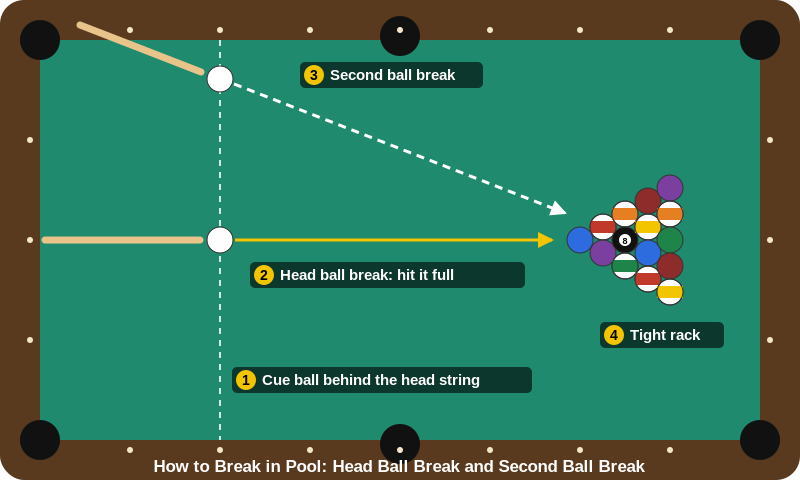
The break is said to be one of the most important shots in the game of pool. Many games are won or lost on the break. I have played pool for over 50 years, and the good news is that a strong break is not about being the biggest or the strongest player. It is about a good rack, a full hit, and a smooth stroke.
How Do You Break in Pool?
The break is the first shot of the game. You hit the cue ball into the racked balls to spread them out. A good break does three things. It makes a ball, so you keep shooting. It spreads the balls so you have shots. And it leaves the cue ball on the table, close to the middle, so you have a good first shot.
Our older page, How to Play Pool: 8 Ball Break, has the video that started this lesson. Our best advice there still holds: when breaking in 8 ball, always strike the ball in the rack you are aiming for as full as possible.
What Is a Legal Break in Pool?
Before you work on power, know the rules. Under the official 8 ball rules on our site:
- The cue ball must start behind the head string. The head string is the line across the table where the cue ball sits for the break.
- To make a legal break, you must make a ball, or drive at least four numbered balls to a rail.
- If the break is not legal, it is a foul. The other player can take the table as it is, or have the balls racked again and choose who breaks.
- The break is not a called shot. If you make a ball on a legal break, you keep shooting.
In 9 ball, the breaker must hit the 1 ball first, then make a ball or drive at least four numbered balls to a rail. See all the rules on our 8 ball rules and 9 ball rules pages.
How to Break in Pool for Beginners: 7 Simple Steps
Step 1: Rack the Balls Tight
No stroke can fix a loose rack. Under the official rules on our site, the 8 ball goes in the center of the rack, the front ball sits on the foot spot, and the two back corners get one stripe and one solid. Put your fingers behind the back balls and hold them tight. Then push forward and lift the rack off without moving the balls. A tight rack will spread when you break it. Learn how on our 8 Ball Rack the Rack page.
Step 2: Set the Cue Ball Behind the Head String
For a head ball break, set the cue ball near the middle of the table, behind the head string. For the second ball break, set it about one ball width off the side rail. Pick one spot and use it every time so you can learn what it does.
Step 3: Line Up Your Body First
Stand behind the shot and line your body up on it before you get down. In our break video, the first thing in the pre shot routine is getting the body straight over the shot, with the right heel lined up with the shot. Then get your feet set and get down.
Step 4: Use a Longer Bridge and a Relaxed Grip
Make your bridge a little longer than normal. That gives the cue more room to build speed. Hold the cue loose, with just a couple of fingers. A tight grip does not add power. It makes the cue twist and jerk. See our how to hold a pool cue page for more on the grip.
Step 5: Aim to Hit the Head Ball Full
Aim the break like any other important shot. Hit the ball in the rack you are aiming for as full as you can. A full, square hit sends the most power into the rack. A thin hit sends the cue ball flying and can make you scratch.
Step 6: Set, Pause, and Finish
Take your practice strokes and get set. Then pause on the back swing. The pause on the back swing seems to make the break better, and it helps keep the stroke smooth. Then finish: stroke straight through the cue ball and let the cue keep going.
Step 7: Hit the Cue Ball Near the Center
Hit the cue ball near the center, with no side spin, and keep the cue as level as you can. You want the cue ball to hit the rack and stop near the middle of the table. If it flies back to you or runs to a pocket, change one thing at a time on the next break.
How to Break in Pool 8 Ball: 3 Common Breaks
Here are 3 common breaks you will see in 8 ball. They come from our break and rack videos:
- Head ball break: Set the cue ball near the middle and shoot into the head ball head on. You will see this break a lot in bars, and with a tight rack the balls really spread out.
- Angle break into the head ball: Set the cue ball off to one side and hit the head ball full from an angle. Many tournament players use it.
- Second ball break: Set the cue ball about one ball width off the side rail and hit the second ball in the rack nice and full. This break was taught to us years ago by Tom Rossman, Dr. Cue, and it gives you a pretty good chance to make the 8 ball. It is tricky, because you can hop the cue ball off the table.
Why does making the 8 matter? In APA and many other leagues, the 8 on the break is a win. In BCA, it is not a win, and you can choose to spot it and keep shooting or rack again. Watch the second ball break and the head ball break in this video from our Pool Skool channel.
How to Break in Pool With Power (and Control)
Everyone wants a big break. But power is the last thing to add. If you hit hard and miss the head ball, you lose most of the power, and the cue ball can jump off the table. Use this simple plan:
- Break at a medium speed until you hit the head ball full every time.
- Watch where the cue ball stops. Try to make it stop near the middle.
- Add a little more speed only when the hit stays full and the cue ball stays in control.
- If the hit gets sloppy, slow back down.
A smooth stroke that speeds up through the ball gives you more power than a jerky, all out hit. Our how to shoot pool page shows the stroke basics.
Pool Break Rules: Scratch and the 8 on the Break
These come from the rules already on our site. Always ask, "What rules are we playing?" before the first break.
- Scratch on a legal break in 8 ball: balls you made stay down (except the 8), it is a foul, and the table is open. The other player gets ball in hand behind the head string.
- Make the 8 and scratch on the break: the other player can rack again, or spot the 8 and shoot with ball in hand behind the head string.
- Jump a ball off the table on the break: it is a foul. The other player can take the table as it is, or take ball in hand behind the head string.
- Open table: right after the break, no one has stripes or solids yet, even if balls went in. Under bar rules, a ball made on the break may pick your group.
- Scratch on the break in 9 ball: it is a foul, and the other player gets ball in hand anywhere on the table.
For more, see our pool scratch rules and official billiard rules pages.
How to Break Better in Pool: 5 Common Mistakes
- A loose rack. Ask for a tight rack, or rack it again.
- Hitting too hard. Speed you cannot control makes you miss the head ball.
- Squeezing the cue. Keep the grip loose.
- Jumping up. Stay down through the stroke so your aim does not move.
- Using side spin. Side spin makes the hit less full and can send the cue ball into a pocket. Hit near center.
After a good break, you still have to run the balls. Our cue ball control page and pre shot routine page will help you take over the table.
Learn to Break and Run Free
A good break starts with good fundamentals. Our free 7 part pool fundamentals course covers the stance, bridge, grip, and stroke, one lesson at a time by email. To get it, fill out the form on our billiard drills page.
Once you make a ball on the break, you need a plan for the rest of the rack. Our book 8 Ball Winning Strategies shows you how to plan your run and play smart 8 ball. Learn more on our 8 Ball Winning Strategies page.
Frequently Asked Questions
What is a legal break in pool?
Under the official 8 ball rules on our site, the cue ball must start behind the head string. Then you must make a ball, or drive at least four numbered balls to a rail. In 9 ball, you must also hit the 1 ball first.
What happens if you scratch on the break?
In 8 ball, any balls you made stay down (except the 8), it is a foul, and the table is open. The other player gets the cue ball in hand behind the head string. In 9 ball, the other player gets ball in hand anywhere on the table.
Who breaks first in pool?
Under the official rules, the players lag for the break, and the winner of the lag can choose to break. After that, players take turns breaking each game.
What happens if you make the 8 ball on the break?
It depends on the rules. Under official BCA rules it is not a win. The breaker can have the balls racked again, or spot the 8 and keep shooting. In APA, TAP, and most other leagues, making the 8 on the break is a win.
How hard should you break in pool?
Only as hard as you can still hit the head ball full and keep the cue ball on the table. A square hit at a speed you control beats a wild, hard hit that misses the head ball.
Where should the cue ball be for the break?
It must be behind the head string. Many players break from near the middle for a head ball break. For the second ball break, set the cue ball about one ball width off the side rail.

Tips, rules, and drills to play better pool