Cue Ball Control: 7 Simple Tips
This page lists every page on this site in one place. Pick a topic below, then click a page to read it. There are 104 pages here.
How to Play
- 8 Ball Secrets and Free Fundamentals
- Billiard Instruction, Basic Fundamentals, Pool Lessons.
- Billiard Lessons
- Billiards Instructions Will Improve Your Game.
- Billiards Tips of Many Here.
- Day 1 Online Billiards Tips and Instruction Basic Training. Free!
- Day 1 Pool Tips and Billiards Instruction, Basic training.
- Find Billiard Schools Here. Play Run Out Pool Now!
- Free Online Billiards Instruction. Learn Basic Fundamentals Here!
- Get Free Pool Billiards Tips Online. Looking for Instruction?
- How To Play Billiards With Fundamental Basics.
- How To Play Billiards. Run Out Pattern.
- How To Play Billiards? Master the Fundamentals of pool.
- How To Play Pool. 8 Ball Break.
- How to Play Pool. 8 Ball Pre Shot Routine.
- Pool Billiards Instruction. Online and Free! Play Pool Now.
- Pool Billiards Tips part 6 of 7 Pool and Billiards Fundamental Basic Training.
- Pool Instruction! Learn Billiards Fundamentals Now. Run Racks.
- Pool Instruction, Billiards Fundamentals. Putting it All Together.
- Pool Lessons With Certified Instructor.
- Pool School Fundamentals brought to you by Billiards Planet .
- Poolbilliardstips from Pool-Billiards-Game dot com. 7 Part tips & Training.
- Pre Shot Routine for Pool and Billiards
Drills and Practice
- Billiard Drills based on the fundamentals of pool and billiards.
- Discover these Cool Billiard Drills. How to Become a Pool Player.
Shots and Aiming
- 8 Ball Pool Online, Defensive Safety Play
- A Pool Game to Play like Eight Ball, Requires Learn about Break Out Shots Here.
- Bank Shots in Pool: 6 Simple Steps to Make More Banks
- Cue Ball Control: 7 Simple Tips to Put the Cue Ball Where You Want
- How to Aim in Pool Better: 5 Mistakes That Make You Miss
Games and Rules
- 14.1 Straight Pool High Run Record: Mosconi, Schmidt, Shaw
- 8 Ball Do Not Stack Your Balls
- 8 Ball Rack The Rack. How to Play Billiards Games.
- 8 Ball Winning Strategies. Learn to Play 8 Ball Pool Online.
- Billiard Game Rules. What rules do you play by?
- Billiard Pool Games
- Billiards Games and How to Play Them.
- Billiards Rule Dude! Let's Play some Pool. 8 Ball or 9 Ball?
- Discover official billiard rules. Do you Know Bar Rules?
- People Fight over Billiard Rules! Why do people fight over a game?
- Play Pool Games Like A Champion.
- Pool and Billiards Game! Online and Off.
- What is Billard? Who is Bobbi? Is it Pool? Sounds like Billiards.
- Which Pool Game to Play?and get
Equipment
- A Billiards Poster can be a nice touch for any Pool Room.
- Billiard Balls Found Here.
- Billiard Chalk is not created equal.
- Billiard Clothing. Isn't it cool to wear Billiards Apparel?
- Billiard Gloves Found Here.
- Billiard Supplies by the Hundreds.
- Billiards Cloth (A.K.A. Pool Table Felt, Here).
- Billiards Cue Sticks at Fantastic Prices.
- Billiards Supplies and Accessories.
- Billiards Table for beginner or advanced player.
- Billiards Tables New or Used?
- Custom Pool-Cues. Pool Player tells all about Pool Cues.
- Diamond Pool Tables, BCA National 8 Ball Tournament.
- Discover Billiard Balls History of , Exploding on the Pool Table!
- My Billiard Table Used to be used primarily for playing pool
- Pool Billiards Tables found Here.
- Pool Cues Review. Billiard Cues. Does the Cue Make The Player?
- Pool Cues at Great Prices. Get Billiards Cue Deals Here
- Pool Stick, more commonly known as Pool Cue.
- Pool Table For Sale Cheap. Would you like A Billiards Table?
- Pool Table Lights Here.
- Pool Tables at Killer Prices. Are You looking for a Billiard Table?
- Who Makes The Best Pool Cue?
Book and Affiliates
- 8 Ball Strategies Special offer
- 8 Ball Winning Strategies Affiliate Program | Earn 50% on ClickBank
- Testimonial
Other
- 2013 BCA Vegas Sschedule. New Schedule for Bca in 2013
- Billiards Links and Pool Player Resources.
- Billiards Parlor or Pool Hall. Which sounds better?
- Billiards Planet Editor Becomes Certified Billiards Instructor.
- Billiards Planet News. New Pages on Billiard Pool Games.
- Billiards Planet News. Pool-Billiards-Game New Design and Website
- Billiards Planet News. Reminder Message
- Billiards Planet, Finally had time for Pool Playing News.
- Billiards Planet, Issue #001: Premier. Why We Miss Shots.
- Billiards Planet, Issue #001: Premier. Why We Miss Shots.
- Billiards Planet, Issue #002: What's Your Favorite Pool Game?
- Billiards Planet, Issue #003: How Strong is Your Game?
- Billiards Planet, Issue #004: Who is Shane Van Boening?
- Billiards Planet, Issue #005: Are You A Pool Player?
- Billiards Planet, Issue #006: How is Your Mental Game?
- Billiards Planet, Issue #007: Isn't Pool Cool?
- Billiards Planet, Issue #008: Playing Pool Mucho?
- Billiards Planet, Issue #009: May Issue in June.
- Billiards Planet, Not so Frequent Pool - Billiards Update.
- Discover the Dr. Cue, Pool and Billiards Tournament. Pueblo Colorado.
- Dr Cue Pool Tournament Pueblo Colorado 2008
- Dr Cue Pool Tournament Pueblo Colorado 2008
- Happy Easter With Billiards Info
- Home: Pool Billiards Game. How to Play Billiards?
- Legendary Business Match
- Pool Billiards Game Privacy Policy
- Pool Billiards Game Sitemap
- Pool Blog. Stay Up to Date with Pool-Billiards-Game Blog!
- Pool Leagues. Which ones are right for you?
- Pool News. "Billiards Planet". Not a newsletter. It's an E-Zine. Free!
- Pool_Billiards Game, Contact Us Page
- Privacy Policy, Contact Us, Terms of Service
- Pueblo Colorado Pool and Billiards
- Terms of Service
Making a ball is only half of a good shot. The other half is where the cue ball goes next. That is cue ball control. Good players do not just make one ball. They leave the cue ball in a good spot for the next shot, and the next one after that.
I have played pool for over 50 years, and I have played in leagues and tournaments for over 38 years. In this page, I will show you seven simple tips to get better cue ball control.
What Is Cue Ball Control?
Cue ball control means you choose where the cue ball stops after each shot. Players also call it "position" or "shape." If you get good shape, your next shot is easy. If you do not, you have to make a hard shot, or play safe.
You control the cue ball with two things:
- Where you hit the cue ball (high, center, or low).
- How hard you hit it (your speed).
Tip 1: What Are Stop, Draw, and Follow?
These are the three shots every player needs to know first.
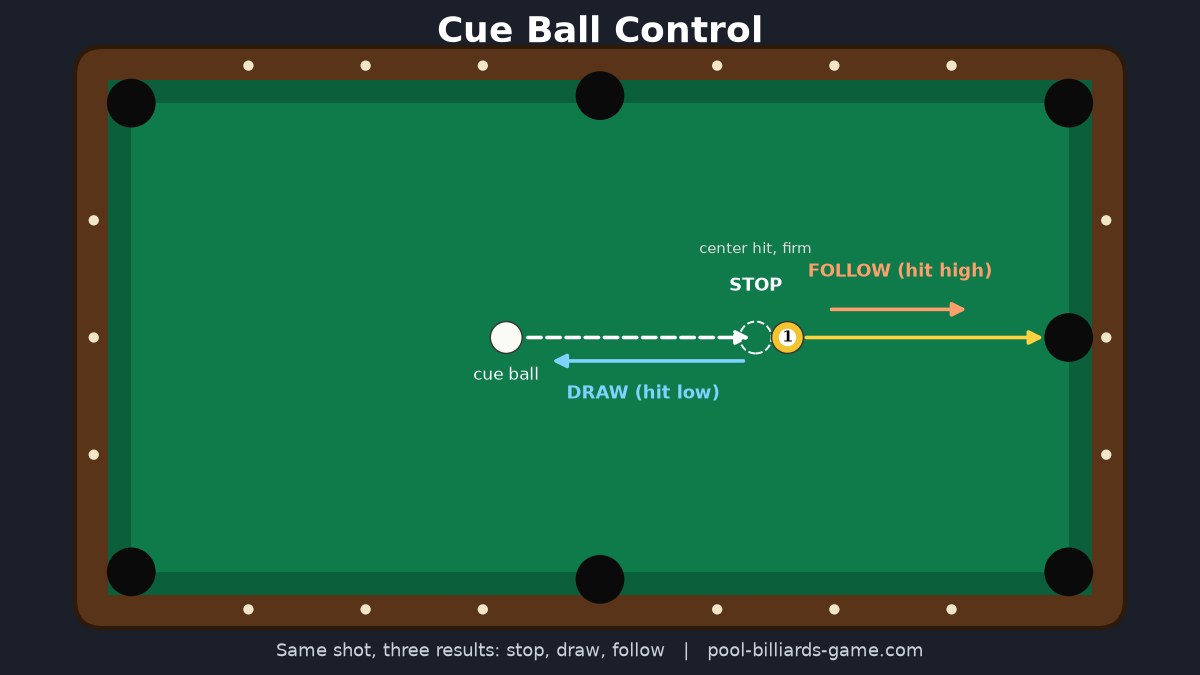
- Stop shot: Hit the cue ball in the center, or a little below, with firm speed. On a straight shot, the cue ball stops dead where the object ball was.
- Draw shot: Hit the cue ball below center. The cue ball spins backward and comes back toward you after it hits the object ball.
- Follow shot: Hit the cue ball above center. The cue ball rolls forward after it hits the object ball.
Look at the picture above. It is the same shot each time. Only the spot where you hit the cue ball changes.
In this video, I show stop, draw, and follow on the table.
Tip 2: Why Should You Learn the Stop Shot First?
The stop shot is the base of cue ball control. If you can stop the cue ball on a straight shot, you know how to hit the center of the cue ball. Every other shot builds from that. Start here before you try big draw shots.
Tip 3: How Do You Hit a Good Draw Shot?
Draw is the shot most players want to learn. Here are a few keys:
- Lower your bridge hand a little so the cue tip can reach below center.
- Keep the cue as level as you can.
- Use a smooth stroke and follow through. Do not jab at the ball.
- Stay down after you hit. Jumping up is a big reason draw shots fail.
Start with the cue ball close to the object ball. Move it back as you get better.
Tip 4: How Does Speed Change Cue Ball Control?
Speed is just as important as where you hit the cue ball. A soft shot with follow rolls a little. A firm shot with follow rolls a lot. Most misses in position come from bad speed, not bad spin.
Try to use the softest speed that still gets the job done. Soft shots are easier to control and the object ball goes in more often.
Tip 5: What Is the Tangent Line?
On a cut shot, the cue ball does not go straight. After it hits the object ball, it heads off at about a right angle to the path of the object ball. This is called the tangent line. It is where a stop shot goes on a cut.
Follow bends the cue ball forward from that line. Draw bends it back. Once you know the tangent line, you can guess where the cue ball will go before you shoot.
Tip 6: Why Should You Think One Shot Ahead?
Before every shot, ask, "Where do I want the cue ball to stop?" Pick a spot, not just a side of the table. Then pick the spin and speed that will get it there.
Good players think two or three balls ahead. Start with one. This is a big part of my pre shot routine. You can read more on our pre shot routine page.
Tip 7: Why Should You Keep It Simple?
New players often use too much spin. Then they miss the ball they are shooting at. The best cue ball control is often the simplest. Use center ball when you can. Add draw, follow, or side spin only when the shot needs it.
Good aim still comes first. If you need help making balls, see our how to aim in pool page.
How Can You Practice Cue Ball Control?
Practice is the only way to get good at this. Our new blog post has easy cue ball control drills you can do in 20 minutes. Our billiard drills page has more.
You can also get my free pool drills and fundamentals training by email. Sign up on our pool tips page and it will come to your inbox.
How Does Cue Ball Control Help You Win at 8 Ball?
In 8 ball, you have to run your group of balls and then the 8. Cue ball control is what lets you run out. It also helps you play good safeties when you do not have a shot. My book 8 Ball Winning Strategies shows you how to plan your run and play smart 8 ball. See what is inside on the 8 Ball Winning Strategies page.
Quick Recap
- Learn stop, draw, and follow.
- Master the stop shot first.
- Stay low and follow through on draw.
- Speed matters as much as spin.
- Know the tangent line.
- Think one shot ahead.
- Keep it simple.
Want more help? Visit our billiards fundamentals page, our bank shots in pool page, or go back to the Pool Billiards Game home page.