Cue Ball Control Drills: 6 Easy Drills for Beginners
Quick answer: The best cue ball control drills for beginners are the stop shot ladder, follow it in, draw to a target, and the speed ladder. Then add the tangent line drill and a 3 ball run out. Each drill uses one simple setup and a target, so you know right away if the cue ball went where you wanted. You can do all six alone.
A good player does not just make the ball. They also pick the spot where the cue ball will stop. You can read about spin all day, but the only way to get real cue ball control is to practice it. I have played pool for over 50 years, and these are simple drills we like because they give you a clear goal on every shot.
New to stop, follow, and draw? Read our cue ball control page first. It explains what each shot does and why speed matters. This page is just the drills.
How Do You Improve Cue Ball Control?
You improve cue ball control in three steps. First, learn to hit the cue ball where you aim on it: center, high, or low. Second, learn your speed, so you know how far the cue ball will roll. Third, put it together and play position from one ball to the next.
The drills below follow those three steps. Drills 1 to 3 teach the hit. Drill 4 teaches speed. Drills 5 and 6 teach position. Before you start, make sure your stroke is straight. If it is not, do the stroke drills on our pool drills for beginners page first.
6 Cue Ball Control Drills for Beginners
Do these cue ball control drills in order. Do not move on until you can do a drill most of the time.
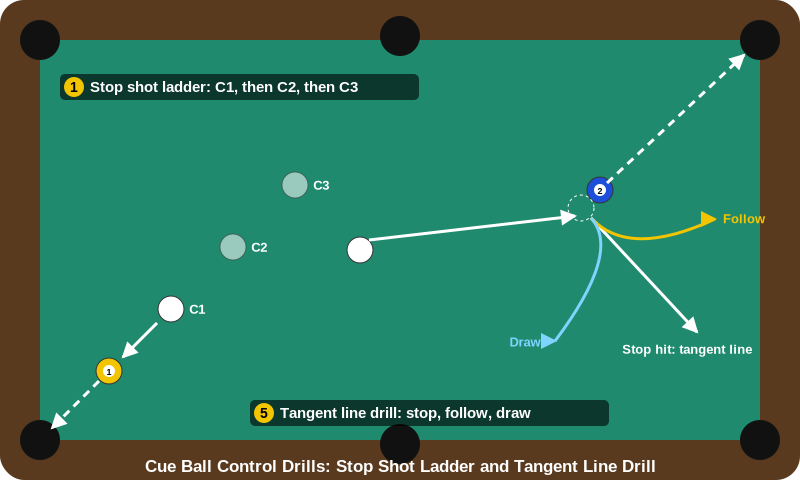
1. The Stop Shot Ladder
This drill teaches you to hit the center of the cue ball.
- Put an object ball about one diamond out from a corner pocket.
- Put the cue ball one diamond behind it, in a straight line to the pocket.
- Shoot a stop shot. The goal is for the cue ball to stop dead where the object ball was.
- When you do it three times in a row, move the cue ball back one more diamond. That is the next step on the ladder.
If the cue ball rolls forward, hit a little lower or a little firmer. If it comes back, hit a little higher. The farther back you go, the harder it gets, because the cue ball has more time to start rolling.
2. Follow It In
This drill comes from part 5 of our free pool course. Set up a straight-in shot. Hit the cue ball about one cue tip above center with a straight, level stroke. The cue ball should follow the object ball right into the pocket. Yes, you scratch on purpose.
Start with close shots, then move to far ones. You will find the far shots much harder. The balls must hit full and straight, and you must follow through. Keep your head down until both balls drop.
3. Draw to a Target
- Use the same straight shot as drill 1.
- Put a piece of chalk on the table one diamond behind the cue ball.
- Hit below center and try to draw the cue ball back to the chalk.
- Move the chalk farther back as you get better.
Stay down and finish your stroke. A short, jabby stroke will not draw the ball. Close shots draw much easier, so start close. When the cue ball starts backing up toward you, there is plenty of time to get out of the way on most shots.
This video from our Pool Skool channel shows the stop, follow, and draw shots you use in drills 1 to 3.
4. The Speed Ladder
Speed is the hidden part of cue ball control. In this drill you change only the speed.
- Set up a straight shot. Put three pieces of chalk past the object ball: one at one diamond, one at two diamonds, and one at three diamonds. Keep them out of the line to the pocket.
- Hit a little above center and make the ball. Try to roll the cue ball to the first target.
- Shoot it again a little firmer, to the second target. Then to the third.
Too soft and the cue ball stops short. Too firm and it rolls too far, or into the pocket. After a while you will start to feel what each speed does. That feel is what lets you play good shape in a real game.
5. The Tangent Line Drill
This drill comes from part 6 of our free pool course. On a cut shot, a stop hit sends the cue ball away from the object ball at close to 90 degrees. That path is the tangent line. Look at the right side of the picture above.
- Stop hit: Hit about half a cue tip below center with a good stroke. The cue ball travels on the tangent line.
- Follow: Hit one cue tip above center. The cue ball bends forward off the line, on a shorter angle.
- Draw: Hit one cue tip below center. The cue ball bends back off the line, and the angle gets wider.
Shoot each one soft, then harder, and watch where the cue ball goes. Then try a little right or left English and see how it changes. Be careful on the draw. With a good stroke you can draw the cue ball right into the corner pocket. To learn more about side spin, see our English in pool page.
6. The 3 Ball Run Out
This drill comes from part 7 of our free pool course, and it puts everything together.
- Rack 3 balls and break them. Try to leave the cue ball near the center of the table.
- Start with an easy shot you can make. Place the cue ball by hand if you need to.
- Run the three balls in order, lowest number to highest.
- Keep going until you can clear the table 9 out of 10 times. Then add a ball and run 4.
Keep adding balls until you can run 9 or 10. Stop your cue ball as much as you can. The more the cue ball travels, the more chances for a mistake. You will start to see 3 ball patterns in every game you play.
A Simple 20 Minute Cue Ball Control Practice Plan
- Five minutes: Stop shot ladder (drill 1).
- Five minutes: Follow it in and draw to a target (drills 2 and 3).
- Five minutes: Speed ladder or the tangent line drill (drill 4 or 5).
- Five minutes: 3 ball run out (drill 6).
Do this a few times a week and write down your scores. Use your pre shot routine on every shot, even in drills. When you see your numbers go up, you know your cue ball control is getting better.
Common Mistakes With Cue Ball Control Drills
- No target. If you do not pick a spot first, you are not drilling. You are just hitting balls.
- Too much spin. Learn center ball first. Add spin only when the shot needs it.
- Hitting too hard. Use the softest speed that gets the job done.
- Jumping up. Stay down until the ball is in the pocket, most of all on draw shots.
- Missing the ball. Cue ball control does not help if the ball does not go in. If you miss a lot, read how to aim in pool.
Get More Cue Ball Control Drills Free
Drills 2, 5, and 6 come from our free 7 part pool fundamentals course. We send it by email, one lesson at a time. To get it, fill out the form on our billiard drills page. You can also read part 4 on English on our billiard drills lesson page.
In 8 ball, cue ball control is what lets you run out and play safe when you need to. Our book 8 Ball Winning Strategies teaches you how to plan your shots and where to leave the cue ball in a rack of 8 ball. Learn more about the book on our 8 Ball Winning Strategies page.
Frequently Asked Questions
What are the best cue ball control drills for beginners?
Start with the stop shot ladder, then follow it in, draw to a target, and the speed ladder. When those feel easy, do the tangent line drill and the 3 ball run out.
How do you improve cue ball control?
Learn the stop shot first, then follow and draw. Practice with targets so you know if the cue ball went where you wanted. Most position misses come from bad speed, so drill your speed too.
How do you practice cue ball control alone?
Set up the same shot every time, put a piece of chalk where you want the cue ball to stop, and count how many times you get close. Move the target as you get better.
Why does my cue ball roll forward on a stop shot?
It usually means you hit the cue ball too high or too soft. Hit a little lower and a little firmer, and keep your cue level.
How long should I practice cue ball control drills?
There is no set time. About 20 focused minutes a few times a week is a good start. A short session where you pick a target for every shot will help more than hours of just shooting.
Tips, rules, and drills to play better pool