Pool Drills for Beginners: 7 Simple Drills to Practice Pool Alone
Quick answer: The best pool drills for beginners are simple. First, build a straight stroke with the cover the seam drill, the bottle drill, and the cue ball down and back drill. Then make straight-in shots, learn the stop shot, and practice stop, follow, and draw. You can do every one of these drills alone, with just a table, a cue, and a few balls.
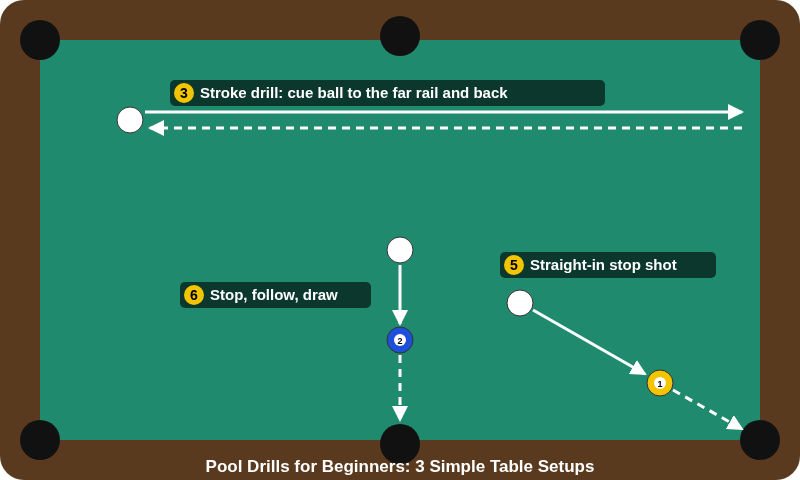
Pool drills for beginners: three of the simple table setups on this page. The numbers match the drills below.
Playing games is fun, and you should play. But drills are how you get better fast. A drill is one shot or one skill that you repeat until it feels easy. I have played pool for over 50 years, and the drills below are the same basics I teach in my free 7 part pool fundamentals course.
Why Should Beginners Do Pool Drills?
When you just play, you might see a shot once a night. In a drill, you shoot that shot again and again. That is how your body learns it. As I say in my course, practice is the most important thing when it comes to improving your game.
Drills also show you what is wrong. If the cue ball does not come back straight, your stroke is off. If the ball misses the pocket on a straight shot, something in your aim or stroke needs work. Before you start, make sure you know how to hold a pool cue and how to make a solid pool bridge hand. Drilling bad habits just makes them stick.
7 Pool Drills for Beginners
Do these drills in order. The first three build your stroke. The next three build shot making and cue ball control. The last one shows you what side spin does.
1. Cover the Seam Stroke Drill
Find the straight line where the rail meets the cloth. That line is the seam. Set your cue right over the seam. Step into the shot and line your body up. Take a few practice strokes, keeping the cue right over the line. Then stroke through and follow through all the way. Practice until you can cover the seam the whole way and it feels smooth.
This drill gets you in the habit of a straight, smooth stroke. Do it every day before you shoot at any balls. Here is a short video from my Pool Skool channel that shows how.
2. The Open Bottle Drill
Put a clean, empty pop bottle on its side on the table, near the head spot. Set your bridge hand where it would be if the cue ball were on the head spot. Now stroke your cue in and out of the small opening of the bottle without touching the sides.
This drill keeps your bridge hand still and your stroke smooth and level. Keep your head down and follow through to the end of your stroke. You can see this drill in my Pool Skool video Develop Straight Billiard Stroke. Shoot Open Bottle.
3. Cue Ball Down and Back
Put the cue ball near the head rail, on the long string down the middle of the table. Line your body up. Hold your cue straight and level. Hit the cue ball dead center and shoot it straight down the table to the far rail. Keep your head down and leave your cue out where it finished.
If you hit the ball in the center, stroke straight, and the table is level, the cue ball will bounce off the far rail and roll straight back into your cue tip. Practice this with a slow, a medium, and a hard stroke. If the cue ball comes back to one side, you hit it off center or your stroke was not straight.
4. Straight-In Line of Balls
Line up some balls near the head rail or the foot rail. Shoot each one straight, the length of the table, into the pocket at the other end. On each shot, check these things:
- Line up on the shot. Get your body and stance right.
- Look straight down your cue to the ball and into the pocket.
- Follow straight through the ball with your stroke.
- Keep your head down and your cue out until the ball is in the pocket.
In my course, the goal for this drill is 100 balls in a row. If you miss, start over. That is a big goal, so start with a smaller count and work your way up.
5. The Straight-In Stop Shot
Put an object ball a little way out from a corner pocket. Put the cue ball behind it on a straight line to the pocket. Make the ball and try to make the cue ball stop right where it hit the object ball. Hit the cue ball a little below center with a firm, smooth stroke.
The stop shot is a great test. If the cue ball rolls forward, you hit it too high or too soft. If it spins off to the side, you hit it off center. When you can do it a few times in a row, move the cue ball farther back.
6. Stop, Follow, Draw
Put the cue ball in the middle of the table. Put an object ball about halfway between the cue ball and a side pocket. First, make the ball with a stop shot. Next, hit the cue ball above center so it follows the object ball into the pocket. Last, hit below center so the cue ball draws back toward you.
Most beginners have the most trouble with the draw shot. Do not move on until you can do each shot most of the time. My page on cue ball control explains how to hit stop, follow, and draw shots.
7. English Off the Rail
Use the same setup as the down and back drill. Shoot the cue ball straight down the table into the center diamond of the far rail. This time, hit it about one cue tip to the right of center. The cue ball will come off the rail to the right. Then try it with left English, and it will come off to the left.
How much it turns depends on how much spin you use and how fast the ball is going. Shoot the cue ball off the rails with and without side spin. This will help you learn how to control the cue ball off a rail. Learn more on my English in pool page and in part 4 of my course, billiard drills.
How to Practice Pool Alone
You do not need a partner to practice. In fact, practice alone is often better, because you can shoot the same shot as many times as you want. Here are a few tips:
- Have a plan. Pick one or two drills before you start.
- Set up the same shot each time. You can mark the ball spots with small paper stickers so every try starts from the same place.
- Keep score. Count how many you make in a row. Try to beat it next time.
- Use your pre shot routine on every shot. See my page on the pre shot routine.
- Do not just bang balls. Shoot every ball like it counts.
A Simple Beginner Practice Plan
Here is one easy way to use these pool drills for beginners in one session:
- Warm up: Cover the seam and the bottle drill (drills 1 and 2).
- Stroke check: Cue ball down and back with a slow, medium, and hard stroke (drill 3).
- Make balls: Straight-in line of balls and the stop shot (drills 4 and 5).
- Control: Stop, follow, draw, then English off the rail (drills 6 and 7).
Set regular practice times and stick to them. A little practice often will help you more than one long session once in a while.
Common Mistakes When Doing Pool Drills
- Skipping the stroke drills. They feel boring, but a straight stroke is the base of every shot.
- Lifting your head. Stay down until the ball is in the pocket.
- Hitting too hard. Use a smooth stroke. Speed comes later.
- Using English on every shot. Learn center ball first.
- Not checking your aim. If you miss straight shots, read how to aim in pool.
Get More Pool Drills for Beginners Free
These drills come from my free 7 part pool fundamentals training. It comes by email and walks you through the basics one lesson at a time, with diagrams and drills. Sign up on the billiard drills page. You can also read the lessons on pool instruction and pool school.
When your basics are solid, my book 8 Ball Winning Strategies shows you how to think through a rack and play smart 8 ball. See what is inside on the 8 Ball Winning Strategies page.
Frequently Asked Questions
What are good pool drills for beginners?
Good pool drills for beginners are stroke drills like cover the seam and cue ball down and back, straight-in shots, the stop shot, and the stop, follow, draw drill. They build a straight stroke and a center hit.
How do you practice pool alone?
Pick one or two drills, set up the same shot each time, and keep score. Warm up with a stroke drill, then shoot straight-in shots, then work on cue ball control.
What is the first pool drill a beginner should learn?
Start with a stroke drill. Shoot the cue ball to the far rail and back to your cue tip. If it comes straight back, your stroke and your center hit are good.
Can you practice pool without a table?
You can practice your stroke without a table. Stroke your cue over a straight line, or through the neck of an empty bottle, and keep your cue straight and level.
How long should a beginner practice pool?
There is no set time. Short practice where you focus on every shot is better than long practice where you just hit balls. Set regular practice times and stick to them.
Tips, rules, and drills to play better pool