Ball in Hand Rules in Pool: What Is Ball in Hand? 7 Rules to Know
Quick answer: Ball in hand means you get to pick up the cue ball and put it anywhere on the table, then shoot. Under the official rules, you get ball in hand when your opponent fouls, like a scratch or hitting the wrong ball first. After a scratch on the break, the cue ball goes behind the head string instead. Bar rules have no ball in hand at all.
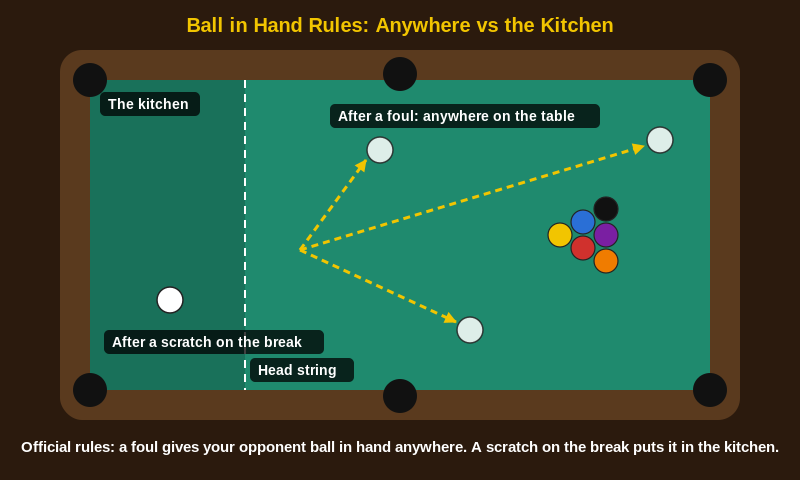
Ball in hand is one of the biggest rules in pool. It can win or lose a game for you. I have played pool for over 50 years, and I have played in leagues and tournaments for over 38 years. Around age 16, nine ball became my game of choice. I liked the ball in hand rules and the fast pace of the game. The rules below come from the official billiard rules and billiard game rules pages on this site.
Ball in Hand Rules: 7 Rules to Know
Rule 1: What Ball in Hand Means
Under the official 8 ball rules, the foul penalty is cue ball in hand for the other player. That means they can place the cue ball anywhere on the table. It does not have to be behind the head string, except on the opening break. Then they shoot at any legal ball.
Why is this the rule? The official rules say it stops a player from making a foul on purpose to put the other player in a bad spot.
Rule 2: What Gives You Ball in Hand (Fouls)
You get ball in hand when your opponent fouls. Common fouls are:
- Scratch: the cue ball goes in a pocket.
- Wrong ball first: the cue ball hits the other player's ball first (or, in 9 ball, not the lowest ball first).
- No rail: after the hit, no ball goes in and no ball touches a rail.
- Ball off the table: a ball is knocked off the table.
If a player makes more than one foul on the same shot, it only counts as one foul. See our pool scratch rules page for more on scratches.
Rule 3: Ball in Hand vs the Kitchen
The head string is the line across the table where you break from. The area behind it is called the kitchen. Ball in hand behind the head string is not the same as ball in hand anywhere.
- Ball in hand anywhere: after a normal foul under the official rules.
- Ball in hand behind the head string: after a scratch on the break.
When you have the cue ball in the kitchen, you can not shoot at a ball that is behind the head string, unless the cue ball first goes past the line. The cue ball can not sit right on the head string, either. It must be behind it.
Rule 4: How to Place the Cue Ball
With ball in hand, you can use your hand or any part of your cue, even the tip, to move the cue ball into place. You can move it around until you are happy, as long as it is not touching a ball.
Be careful here. When you place the cue ball, any forward stroke that touches the cue ball is a foul, unless it is a legal shot. So set it with your hand, then get down and shoot.
Rule 5: Ball in Hand in 8 Ball
In 8 ball, after a foul, your opponent gets ball in hand anywhere. Here is the big one people ask about. Under the official BCA rules, a scratch or foul while you shoot at the 8 ball is not a loss, as long as the 8 ball does not go in or leave the table. Your opponent gets ball in hand. In APA and TAP leagues, a scratch on the 8 ball is a loss.
If the breaker makes the 8 and scratches on the break, the other player chooses. They can rack again, or spot the 8 and shoot with ball in hand behind the head string. See all the details on our 8 ball rules page.
Rule 6: Ball in Hand in 9 Ball
In 9 ball, the game starts with the cue ball in hand behind the head string for the break. After that, after any foul, the other player gets ball in hand anywhere on the table. Balls you made on a foul stay down. The one exception is the 9 ball. If the 9 goes in on a foul, it gets spotted. Read more on our 9 ball rules page.
Rule 7: Bar Rules Have No Ball in Hand
There is no ball in hand when you play bar rules, also called straight 8. When a player scratches or knocks the cue ball off the table, the other player shoots from behind the head string. A table foul, where no ball is hit or no rail is touched, is only loss of turn. That means a player can just roll the cue ball up to a cluster and leave you buried. Read more about bar rules on our billiard rules page.
Ball in Hand vs Scratch: What Is the Difference?
A scratch is one kind of foul. Ball in hand is the penalty for a foul. So a scratch gives your opponent ball in hand under the official rules. But you can also give up ball in hand without a scratch, like when you hit the wrong ball first or no ball touches a rail.
Ask Which Rules You Are Playing
Most leagues and tournaments play ball in hand rules. Many bar players play cue ball behind the head string. That is why you always ask, "What rules are we playing?" before the first break. Know if it is ball in hand or the kitchen, and call pocket or call shot. Ball in hand is a big edge, so a foul can cost you the game. That also makes good defense worth learning. See our safety shot in pool page.
Win More Games of 8 Ball
Knowing the rules is step one. My book 8 Ball Winning Strategies is written for ball in hand, call pocket play. It shows you how to plan your run out, when to play a safety and when to run out, and how to win more games. Learn more on our 8 Ball Winning Strategies page, or read our 8 ball strategy tips.
Learn the Fundamentals Free
Our free 7 part pool fundamentals course covers stance, bridge, stroke, and more, one lesson at a time by email. Sign up on our free pool lessons page.
Ball in Hand Rules FAQ
What is ball in hand in pool?
Ball in hand means you pick up the cue ball and put it anywhere on the table you want. Then you shoot. You get ball in hand when your opponent fouls, under the official rules.
What gives you ball in hand in pool?
A foul by your opponent. Common fouls are a scratch, hitting the wrong ball first, no ball touching a rail after the hit, and knocking a ball off the table.
Is a scratch ball in hand?
Under the official rules, yes. After a scratch, your opponent gets ball in hand anywhere on the table. The one exception is a scratch on the break. Then the cue ball goes behind the head string.
What is the difference between ball in hand and the kitchen?
Ball in hand means anywhere on the table. Cue ball in the kitchen means behind the head string only. You get the kitchen after a scratch on the break, and in bar rules after any scratch.
Can you use your cue to move the cue ball with ball in hand?
Yes. The official rules say you can use your hand or any part of your cue, even the tip, to place the cue ball. But if a forward stroke touches the cue ball, it is a foul.
Is there ball in hand in bar rules?
No. In bar rules there is no ball in hand. After a scratch, the next player shoots from behind the head string. A table foul is only loss of turn.
Know someone who argues about pool rules? Post this ball in hand rules page on X.

Tips, rules, and drills to play better pool