8 Ball Strategy: 7 Simple Tips to Win More Games of 8 Ball Pool
Quick answer: The best 8 ball strategy is to think before you shoot. Break well, pick the group with the fewest trouble balls, plan your out from the 8 ball back, break out clusters early, and never clear your balls unless you can finish the rack. If you can not get out, get safe. These 7 tips show you how.
Most players lose at 8 ball for the same reason. They walk up and shoot the easiest ball, then the next easiest ball, and then they get stuck. Good 8 ball strategy is not about fancy shots. It is about making smart choices. I am a certified billiards instructor. I have played pool for over 50 years, and I have played in leagues and tournaments for over 38 years. Here are the 7 tips I wish every new 8 ball player knew. They are for ball in hand, call pocket play, the way most leagues and tournaments play.
8 Ball Strategy: 7 Simple Tips
Tip 1: Break Well and Keep the Cue Ball on the Table
The break may be the most important shot in 8 ball. Many games are won or lost right there. A simple break is to hit the head ball full, with a level cue and a hit in the middle of the cue ball. Follow through. You want the cue ball to hop back near the center of the table.
The big rule is this: keep the cue ball on the table. If you scratch or knock the cue ball on the floor against a good player, you will likely lose the game. A tight rack helps a lot, too. See our how to break in pool and how to rack pool balls pages.
Tip 2: Pick Solids or Stripes by the Trouble Balls
After the break, do not just pick the group with the easy first shot. Look at the whole table. Find the trouble balls. These are balls stuck in a cluster, frozen on a rail, or blocked from every pocket.
- Count the trouble balls in each group.
- Check that each ball has a pocket it can go in.
- Pick the group that looks easier to run out.
In my break and run video below, the solids had some real tough shots, but all of the stripes had pockets and nothing needed to be broken out. That made the choice easy. I took the stripes.
Tip 3: Plan Your Out From the 8 Ball Back
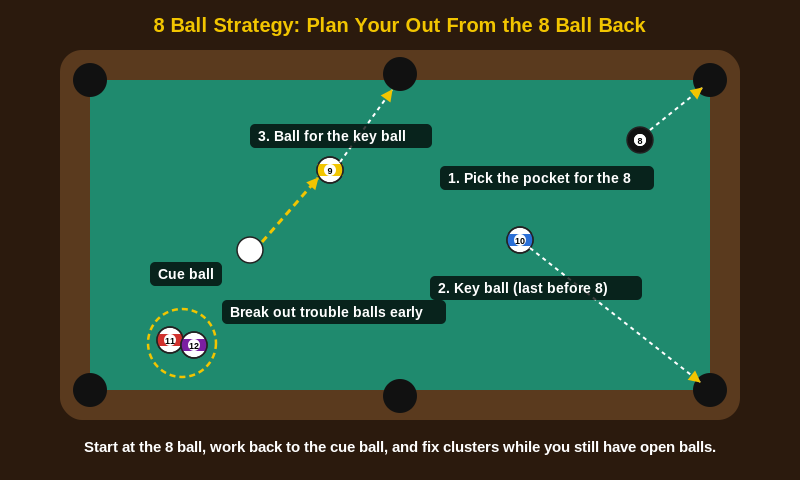
I like to start with the 8 ball and work my way back. First, pick the pocket for the 8. Next, pick the ball you will shoot just before the 8. That is your key ball. It should be an easy shot that leaves you a simple shot on the 8. Then pick the ball before that one, and so on, back to the cue ball.
Try to move the cue ball as little as you can. Short, simple moves are easier to control than long trips around the table. Our cue ball control and stop shot in pool pages show you how. And be ready to change your plan. If a ball rolls too far, stop, look again, and make a new plan.
Tip 4: Break Out Trouble Balls Early
I see way too many players save the break out shot until the very end. Sometimes that works. When it fails, you have no other balls left to help you, and nowhere to hide. Your best bet is to go for the break out early in the rack, while you still have open balls to play.
- Look for a shot where you can make a ball and send the cue ball into the cluster at the same time.
- Use only the speed you need.
- Be careful not to knock the balls you break out into a new cluster or behind another ball.
A draw shot is often the tool for the job.
Tip 5: Do Not Commit 8 Ball Suicide
This is the tip I repeat the most. Never make all of your balls and leave just one tough ball or the 8 ball, and then give your opponent a shot. I call that 8 ball suicide.
Here is why. A table with no balls in the way is very easy to run, even for an average player. When your balls are still on the table, they block pockets and get in the way of your opponent. So only clear the table when you are sure you can finish the rack. If you do the chores, finish the job.
Tip 6: Get Safe or Get Out
Early in each turn, decide if you can run out or if you need to play safe while you open up your balls. Here is my rule of thumb:
- If I can make the safety with pretty good certainty, and the shot to pocket a ball and break out is tough, I play safe.
- If the safety is as hard or harder than the shot, I play offense and go for the shot.
With a little planning, you can often go for the break out and still have a safety ready for the next shot. Learn the basics of defense on our safety shot in pool page.
Tip 7: Stay Calm on the Money Ball
Everyone misses an easy 8 ball once in a while. Most of the time, it happens because the mind is on the wrong thing. Do not think, "I hope I do not miss" or "I hope I do not scratch." Think about the shot you want, see it go in, and then shoot.
- Use the same pre shot routine on the 8 ball that you use on every other ball. See our pre shot routine page.
- Always play shape with the cue ball on the 8. Send it to a spot on the rail so it does not wander into a pocket.
- Think about clearing the table, not about winning or losing.
Know Which 8 Ball Rules You Play
Strategy changes with the rules. Before you play, ask: Is it ball in hand or cue ball behind the head string? Is it call pocket or call shot? Bar rules, also called straight 8, are different from league rules. In BCA, a scratch on the 8 ball is not a loss if you do not make the 8. In APA, any scratch on the 8 ball is a loss. Read our 8 ball rules and billiard game rules pages so you know what game you are in.
Practice Your 8 Ball Strategy
Strategy only works if your stroke does what you plan. Set up a rack and play it alone. Plan the out before you shoot, then see how close you came. Our how to play pool by yourself page has 5 solo games that are great for this.
Get the Full 8 Ball Plan
These 7 tips are a start. My book 8 Ball Winning Strategies goes much deeper. It shows how to plan your run out pattern after the break, when to play a safety and when to run out, how to handle break out shots, and how to beat the choke on the money ball, with video examples. Learn more on our 8 Ball Winning Strategies page.
Learn the Fundamentals Free
Good strategy needs good basics. Our free 7 part pool fundamentals course covers stance, bridge, stroke, and more, one lesson at a time by email. Sign up on our free pool lessons page.
8 Ball Strategy FAQ
What is the best strategy in 8 ball pool?
Plan your whole run before you shoot. Start with the 8 ball and work back to the ball in front of you. Break out trouble balls early. If you can not run out, play a safety instead of making all of your balls and leaving your opponent an open table.
How do you win at 8 ball?
Break well and keep the cue ball on the table. Pick the group with the fewest trouble balls. Plan your out from the 8 ball back, get safe or get out, and stay calm on the money ball. Practice on a regular basis so your stroke does what you plan.
Is it better to be solids or stripes in pool?
Neither group is better by itself. Pick the group that is easier to run on that rack. Look for balls that are in clusters, frozen on a rail, or blocked from the pockets. The group with fewer trouble balls is usually the better pick.
What is the best way to break in 8 ball pool?
Hit the head ball full with a level cue and a good follow through, and try to keep the cue ball near the center of the table. Most of all, keep the cue ball on the table. A scratch or a cue ball on the floor on the break can cost you the game.
Should you always try to run out in 8 ball?
No. Only go for the out when you have the out. If you see a ball you can not get to, play a safety and work on the problem. Running all but one or two of your balls and then missing is what I call 8 ball suicide.
Know someone who wants to win more at 8 ball? Post this 8 ball strategy page on X.

Tips, rules, and drills to play better pool