Stop Shot in Pool: How to Stop the Cue Ball Dead in 7 Easy Steps
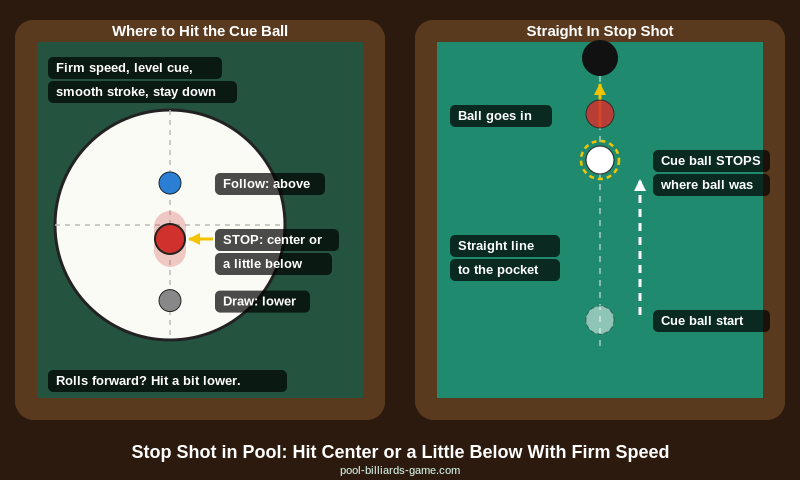
Quick answer: To hit a stop shot in pool, line up a straight in shot. Hit the cue ball in the center or a little below, with firm speed and a smooth stroke. Keep the cue level, follow through, and stay down. The cue ball should stop dead right where the object ball was.
The stop shot is the first shot I tell players to learn. It is the base of cue ball control. If you can stop the cue ball on a straight shot, you know how to hit the center of the cue ball, and every other shot builds from that. I have played pool for over 50 years, and the stop shot is one of the three basic shots in my free fundamentals course, along with the draw shot and the follow shot.
What Is a Stop Shot in Pool?
A stop shot makes the cue ball stop dead after it hits the object ball. The object ball goes in the pocket, and the cue ball stays right where the object ball was.
For a true stop shot, the balls must be lined up straight into the pocket. On a straight shot, the cue ball hits the object ball full in the face. If the cue ball has no forward roll and no back spin when it gets there, it gives all its speed to the object ball and stops. Some players call this a stun shot. A stop shot is a stun shot that is straight in.
How to Do a Stop Shot in Pool: 7 Easy Steps
Start with an easy shot. Put an object ball about one diamond out from a corner pocket. Put the cue ball one diamond behind it, in a straight line to the pocket.
Step 1: Line Up a Straight In Shot
The stop shot only stops dead on a straight shot. Make sure the cue ball, the object ball and the pocket are all on one straight line. If the shot is cut even a little, the cue ball will move off to the side.
Step 2: Chalk Your Cue
Chalk before you shoot. You will hit a little below center, and chalk helps the tip grip the cue ball so it does not slide off.
Step 3: Get in Your Stance
Stand behind the shot, step in, and get your chin down over the cue. Stay balanced so only your stroke arm moves. See our pool stance page and our pool bridge hand page for the steps.
Step 4: Keep the Cue Level
Keep the cue as level as you can. Hold it lightly so your stroke stays smooth. If you grip it tight or raise the back of the cue, the hit will not be clean. See how to hold a pool cue.
Step 5: Aim at the Center or a Little Below
Line up your tip at the center of the cue ball, or a little below. On a short shot, about the center works. In my video, I hit low center with a good stroke, and the ball stops. Do not go too low, or the cue ball will come back toward you. That is a draw shot.
Step 6: Use Firm Speed and a Smooth Stroke
Hit the shot with firm speed and a smooth stroke. Follow through straight. Do not stop the cue when it hits the ball, and do not jab. A shot that is too soft gives the cue ball time to start rolling, and then it rolls forward after the object ball.
Step 7: Stay Down and Watch Where the Cue Ball Stops
Stay down until the ball stops. Then look at what the cue ball did. Did it stop dead, roll forward, come back, or slide to the side? That tells you what to fix on the next shot.
When you can stop the cue ball a few times in a row, move the cue ball farther back and try again. Practice close shots and far shots. The far ones are much harder.
Where to Hit the Cue Ball for a Stop Shot
Think of the face of the cue ball. Here is a simple guide for a straight in shot:
- Center or a little below: a stop shot. The cue ball stops where the object ball was.
- Below center: a draw shot. The cue ball comes back toward you.
- About one cue tip above center: a follow shot. The cue ball rolls forward after the object ball.
The farther the cue ball is from the object ball, the more time the cue ball has to start rolling on the cloth. So on longer stop shots, hit a little lower or a little firmer. On short shots, center ball is often enough.
Stop Shot vs Draw Shot vs Follow Shot
These are the three basic shots in the game. On the same straight in shot, only the spot where you hit the cue ball changes:
- Stop shot: hit the cue ball in the center or a little below, with a firm speed. On a straight shot, it stops dead.
- Draw shot: hit below center. The cue ball spins backward and comes back toward you.
- Follow shot: hit above center. The cue ball rolls forward after it hits the object ball.
Learn the stop shot first, then the draw. Our draw shot in pool page shows how to draw the cue ball back, and our cue ball control page explains all three shots and how speed changes them.
Watch: Stop, Draw and Follow
In this video from our Pool Skool channel, I show the three basic shots on the table. It starts with a straight on shot and the stop shot. To stop the ball, I hit low center with a good stroke, and the ball stops. Then I follow the ball and draw the ball back.
Why Won't My Cue Ball Stop? 5 Common Mistakes
- The cue ball rolls forward. You hit it too high or too soft. Hit a little lower and a little firmer.
- The cue ball comes back. You hit too low. Hit a little higher.
- The cue ball spins off to the side. You hit it off center, left or right. Keep the tip on the center line of the cue ball.
- The cue ball drifts off at an angle. The shot was not really straight in. Line the balls up straight to the pocket.
- Jumping up or jabbing. Stay down, use a smooth stroke, and follow through.
Also, leave side spin out of it while you learn. A stop shot is a center line shot. Our English in pool page covers side spin when you are ready.
The Stop Shot on Cut Shots: The Tangent Line
Most shots in a game are not straight in. On a cut shot, a stop hit sends the cue ball away from the object ball at close to 90 degrees, like a right angle. That path is called the tangent line.
In my free course, I teach that about half a cue tip below center with a good stroke sends the cue ball down the tangent line. Knowing the tangent line helps you see where the cue ball will go before you shoot. It also helps you aim. See our how to aim in pool page.
When Do You Use a Stop Shot in a Game?
The stop shot is a position shot. When the cue ball stops, you know just where it will be for your next shot. That makes it easy to plan a run.
It also helps you stay away from a scratch. On a straight in shot near a pocket, a follow shot can send the cue ball in after the object ball. A stop shot keeps the cue ball on the table. Before every shot, ask, "Where do I want the cue ball to stop?"
Stop Shot Drills
The stop shot ladder. Put an object ball about one diamond out from a corner pocket. Put the cue ball one diamond behind it, in a straight line to the pocket. Shoot a stop shot. When you stop the cue ball three times in a row, move the cue ball back one more diamond. That is the next step on the ladder. If the cue ball rolls forward, hit a little lower or a little firmer. If it comes back, hit a little higher. This drill is on our cue ball control drills page.
Stop, follow, draw. Put the cue ball in the middle of the table and an object ball about halfway to a side pocket. Make it with a stop shot, then a follow shot, then a draw shot. Do not move on until you can do each one most of the time. See our pool drills for beginners page for this drill and more.
Before any of this, make sure your stroke is straight and your body is still. Our how to shoot pool page walks through the full shot, step by step.
Learn the Fundamentals Free
The stop shot is part of our free 7 part pool fundamentals course, along with the draw shot, the follow shot, the tangent line, and English. It comes one lesson at a time by email, so you can study it on the computer and then take it to the table. Sign up on our free pool lessons page. You can also read a lesson from the course on our billiards instruction page.
When you are ready to win more games, our book 8 Ball Winning Strategies shows you how to plan your run and play smart 8 ball. Learn more on our 8 Ball Winning Strategies page.
Stop Shot FAQ
What is a stop shot in pool?
A stop shot is when the cue ball stops dead after it hits the object ball. On a straight in shot, the cue ball stops right where the object ball was. It is one of the three basic shots, along with draw and follow.
Where do you hit the cue ball for a stop shot?
Hit the cue ball in the center or a little below, with firm speed. On longer shots you may need to hit a little lower or a little firmer.
Why does my cue ball roll forward on a stop shot?
It usually means you hit the cue ball too high or too soft. Hit a little lower and a little firmer, and keep your cue level.
Why does my cue ball come back on a stop shot?
You hit too low, so the cue ball still had back spin when it hit the object ball. That is a small draw shot. Hit a little higher.
What is the difference between a stop shot and a draw shot?
On a stop shot you hit the cue ball in the center or a little below, and on a straight shot it stops where the object ball was. On a draw shot you hit lower, and the cue ball comes back toward you.
Is a stop shot the same as a stun shot?
They are close cousins. A stun shot is when the cue ball is sliding with no spin when it hits the object ball. On a straight shot, that makes the cue ball stop, so a stop shot is a stun shot that is straight in. On a cut shot, a stun hit sends the cue ball off on the tangent line instead.
Know someone learning pool? Post this stop shot page on X.
Tips, rules, and drills to play better pool