Kick Shot in Pool: How to Kick the Cue Ball Off a Rail in 7 Easy Steps
Quick answer: A kick shot in pool is when the cue ball hits a rail first, then hits the object ball. To aim a simple one rail kick, use angle in equals angle out (the same idea as a bank). Pretend the rail is a mirror, find the spot on the rail that sends the cue ball to the object ball, then shoot the cue ball at that spot with a smooth, center hit.
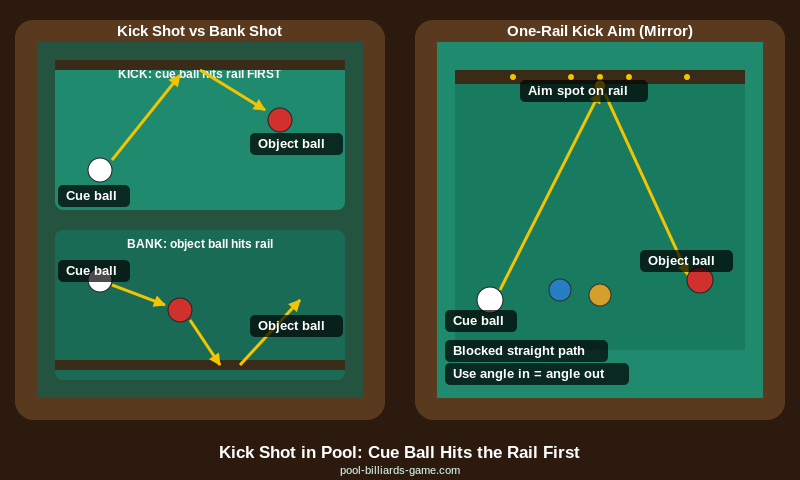
I have played pool for over 50 years. Kick shots come up when another ball blocks your straight path, or when your opponent plays a safety and leaves you no open shot. Once you see the simple rail aim, kicks stop feeling like a guess.
What Is a Kick Shot in Pool?
A kick shot is when the cue ball hits a rail first, then hits the object ball. That is the definition we use on our bank shots in pool page.
Do not mix it up with a bank shot. In a bank shot, the object ball hits the rail and then goes to a pocket. In a kick shot, the cue ball takes the rail.
Under common 8 ball rules, it is legal to send the cue ball off a rail before it contacts your object ball. After that contact, you still need a legal shot result (a ball pocketed, or a ball to a rail), the same as any other shot. See our official billiard rules and our 8 ball rules pages for the full wording used on this site.
Kick Shot vs Bank Shot
- Kick shot: cue ball hits the rail first, then the object ball.
- Bank shot: object ball hits the rail, then goes toward a pocket.
Both shots use the same basic idea: angle in equals angle out. The difference is which ball takes the rail. If you want the object ball to bounce into a pocket, see our bank page. If you need the cue ball to bounce into the object ball, you are on a kick.
How to Do a Kick Shot in Pool: 7 Easy Steps
Start with a one rail kick. Put an object ball near a side or corner pocket area. Put one or two blocker balls on the straight line between the cue ball and the object ball. Put the cue ball so a path off one long rail can reach the object ball.
Step 1: Decide You Need a Kick
If a straight path is blocked, and a soft safety is not what you want, look for a one rail path. Ask, "Can the cue ball hit this rail, then the object ball?"
Step 2: Remember Angle In Equals Angle Out
A ball that hits a rail bounces off at about the same angle it came in. This is the base of every bank and every simple kick on our site. Real tables are not perfect, and speed and spin change things a little. Start with the equal angle idea first.
Step 3: Use the Mirror Trick on the Rail
Pretend the rail is a mirror. Picture where the object ball would sit if it were reflected across that rail. Aim the cue ball at that pretend target. The spot where that line crosses the rail is your aim spot. If the cue ball hits that spot with a rolling center hit, it should head toward the real object ball.
Step 4: Use the Diamonds as Markers
The little dots on the rails are called diamonds. They are spaced evenly. You can use them to find your spot on the rail, the same way we use them for banks. If the cue ball sits across from one diamond and the object ball sits across from another, the halfway point between them is often close to your kick target on the opposite rail.
Step 5: Aim the Cue Ball Like Any Other Shot
Once you have the rail spot, treat that spot like your target. Use your normal stance, bridge, and stroke. See our pool stance, pool bridge hand, and how to aim in pool pages. A kick is still an aimed shot. The "pocket" is just a spot on the rail.
Step 6: Hit Center Ball at One Steady Speed
For your first kicks, hit the cue ball in the center (or a touch above center so it rolls). Leave side spin out of it. Pick one medium speed and use it over and over. A slow, rolling ball tends to bounce a bit wider. A hard hit ball tends to come off a bit shorter. That is the same speed lesson we teach on banks.
Step 7: Stay Down and Watch the Path
Stay down until the balls settle. Did the cue ball hit the rail spot you picked? Did it reach the object ball full, thin, or miss? That tells you whether to move your aim spot up table or down table on the next try.
How to Measure a Simple One Rail Kick
People search for "how to measure a kick shot in pool" and "how to calculate kick shot in pool." Here is the simple beginner measure we use on this site, based on the same diamond and mirror ideas as our bank page:
- Pick the rail you will kick off.
- Find the diamond (or halfway point) that sits between the cue ball's line and the object ball's line.
- Aim the cue ball at that rail spot with a center hit.
- Shoot the same shot many times and note if you ran long or short.
You do not need a hard math system to start. Measure with the diamonds, shoot, and adjust. Advanced diamond systems exist for multi rail kicks, but one rail mirror kicks will cover a lot of real games.
When Do You Use a Kick Shot in a Game?
Use a kick when:
- Your path to your ball is blocked by another ball.
- Your opponent left you hooked after a safety.
- You need to hit your ball to keep a legal shot, even if you cannot pocket it.
On a kick that only touches your ball and does not pocket anything, remember the legal shot rule: after contact, a ball still needs to hit a rail (or a ball needs to go in), or it can be a foul under the rules pages on this site. When you are stuck, a kick that just reaches your ball and a rail can save the inning better than a wild guess at a pocket.
Knowing when to kick and when to play safe is part of strategy. If you play 8 ball, our book 8 Ball Winning Strategies shows you how to plan your runs and play smart. Learn more on our 8 Ball Winning Strategies page.
Kick Shot Practice Drill
Put two blocker balls on the straight line between the cue ball and an object ball near a corner. Kick one rail into the object ball. Do not try to pocket it at first. Just hit the object ball full in the face ten times. Then try to kick and pocket. Keep the same speed. Change only the rail aim spot when you miss.
After that, practice the same drill off the other long rail. Your how to shoot pool fundamentals still matter here: chalk, stance, smooth stroke, stay down.
Banks and kicks share the rail. When you want the object ball to take the bounce into a pocket, switch to our bank shots in pool page and drill. That page also has a clear bank drill video you can watch after you practice kicks.
Common Kick Shot Mistakes
- Guessing with no aim spot. Pick a diamond or mirror spot first. Then shoot.
- Using side spin too soon. Side spin changes the rebound. Learn center ball kicks first. Our English in pool page covers side spin later.
- Changing speed every shot. Pick one speed so your misses teach you something.
- Hitting too thin or too full by accident. Watch where you contact the object ball, not only the rail.
- Forgetting the legal shot after contact. A kick that barely kisses your ball with nothing to a rail can still foul under standard rules on this site.
Learn the Fundamentals Free
Kick shots sit on top of straight aim, a steady stroke, and cue ball control. Our free 7 part pool fundamentals course covers the basics one lesson at a time by email. Sign up on our free pool lessons page. You can also read a lesson from the course on our billiards instruction page.
For stop, draw, and follow (the three basic cue ball paths after contact), see our cue ball control, stop shot in pool, draw shot in pool, and follow shot in pool pages.
Kick Shot FAQ
What is a kick shot in pool?
A kick shot is when the cue ball hits a rail first, then hits the object ball. A bank shot is different: the object ball hits the rail.
What is the difference between a kick shot and a bank shot?
On a kick, the cue ball takes the rail. On a bank, the object ball takes the rail. Both use angle in equals angle out as a starting point.
How do you do a kick shot in pool?
Find a rail path to your object ball. Use the mirror trick or diamonds to pick an aim spot on that rail. Hit the cue ball center at one steady speed, stay down, and adjust the aim spot from what you see.
How do you measure or calculate a kick shot?
For a simple one rail kick, find the halfway diamond (or mirror point) between the cue ball and the object ball on the rail you will use, aim there with a center hit, then adjust for speed. You do not need advanced formulas to start.
Is it legal to hit a rail before the object ball?
Yes, under the 8 ball rules wording on this site, you may send the cue ball off a rail before contacting your object ball. After contact, you still need a legal result (a pocketed ball, or a ball to a rail), unless a specific game rule says otherwise.
When should you shoot a kick shot?
When your straight path is blocked, when you are hooked after a safety, or when you need to reach your ball to keep a legal shot. If a bank or a safety is clearer, take that instead.
Know someone learning pool? Post this kick shot page on X.
Tips, rules, and drills to play better pool