Lag in Pool: What Is a Lag for Break? 7 Lag Rules to Know
Quick answer: A lag in pool is how players decide who breaks first. Both players shoot a ball from behind the head string at the same time. Each ball rolls to the foot rail and back. The ball that stops closest to the head rail wins the lag, and the winner picks who breaks.
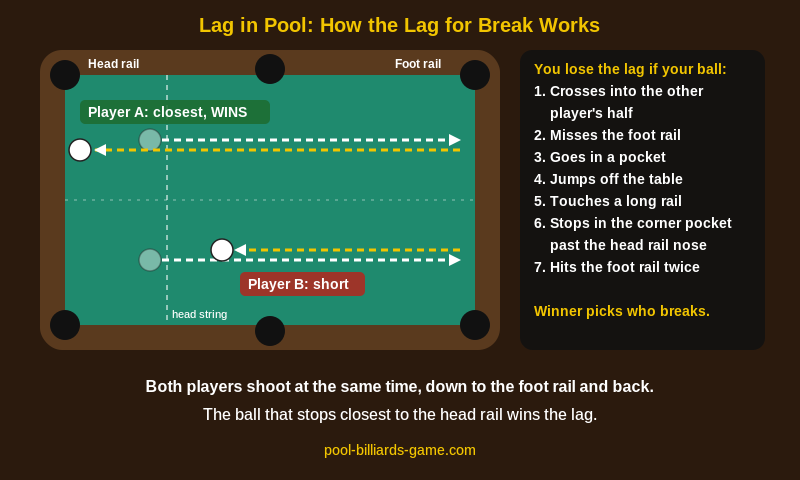
In a league or tournament match, the very first shot is not the break. It is the lag. Win the lag, and you get to choose who breaks. Lose it, and you may sit and watch your opponent run the first rack.
I have played pool for over 50 years, and I have played in leagues and tournaments for over 38 years. The lag rules below come from the official rules on our billiard game rules page. For the whole game of 8 ball, see our 8 ball rules page.
What Does Lag Mean in Pool?
To lag means to shoot a ball down the table and back to see who can stop it closest to the head rail. It is a speed contest. Nobody is trying to make a ball. The player with the best touch wins.
You will also hear it called the lag for break or lagging for the break. They all mean the same thing.
How to Lag for Break: Step by Step
- Each player gets a ball of the same size and weight. Cue balls are best. If you do not have two, use object balls that are not stripes.
- Both players place their ball behind the head string. One player sets up to the left of the head spot, and one to the right.
- Both players shoot at the same time.
- Each ball rolls to the foot rail (the far end), hits it, and rolls back toward the head rail.
- The ball that stops closest to the inside edge of the head rail wins the lag.
Your ball must touch the foot rail at least once. It is fine if it touches the head rail on the way back. Other rail touches do not matter, except the ones in the rules below.
7 Lag Rules: Ways to Lose the Lag
Under the official rules, you lose the lag right away if your ball does any of these 7 things:
1. It Crosses Into Your Opponent's Half
The table is split down the middle the long way. Your ball must stay on your side. If it rolls into the other player's half, you lose.
2. It Misses the Foot Rail
Your ball has to touch the foot rail. If it stops short of the far end, you lose.
3. It Goes in a Pocket
If your lag ball drops into any pocket, you lose.
4. It Jumps Off the Table
If your ball leaves the table, you lose.
5. It Touches a Long Rail
The long rails are the side rails. If your ball touches one, you lose. That is why a straight lag matters.
6. It Stops in the Corner Pocket Past the Head Rail Nose
If your ball rolls back so far that it stops inside a corner pocket, past the nose of the head rail, you lose.
7. It Hits the Foot Rail More Than Once
Your ball should hit the foot rail one time. If it hits it twice, you lose.
What if both players lose? If both players break these rules, or if no one can tell which ball is closer, the lag is a tie. You simply lag again.
What Happens After You Win the Lag?
The winner of the lag gets a choice. You can take the opening break yourself, or you can make your opponent break. The break is then taken with the cue ball in hand behind the head string. Learn how on our how to rack pool balls and how to break in pool pages.
The lag only decides the first break. In the official 8 ball rules, players then take turns breaking each game. Other events pick one of these ways ahead of time:
- Winner of each game breaks the next game.
- Players take turns breaking.
- Loser breaks.
- The player who is behind in games breaks.
Always ask which way your league or tournament uses. In 9 ball, the shot right after the break can be a push out. See 9 ball rules and push out in pool.
Lag or Lot: Do You Have to Lag?
The official rules say the first break is decided by lag or by lot. A lot is a random pick, such as a coin flip. The lag is required in tournaments and other formal matches. In a friendly game, you can do either one. Just agree before you start. You can read the exact wording on our official billiard rules and billiard game rules pages.
4 Tips to Win the Lag
1. Hit the Cue Ball in the Center
Side spin can make the ball come off the foot rail at an angle and drift toward a side rail. Touch a side rail and you lose. A center hit helps the ball roll straight. Learn more about side spin on our english in pool page.
2. Shoot Straight Down the Table
Line up your ball parallel to the long rail on your side. A straight lag stays in your half and away from the side rails.
3. Use a Smooth, Easy Stroke
The lag is all about speed. A smooth, even stroke gives you the same speed again and again. Our cue ball control tips help you learn speed.
4. Practice Lagging Alone
You do not need a partner. Lag a ball to the foot rail and back, and see how close you can get to the head rail. Do it ten times in a row. See more ideas on our how to play pool by yourself page.
Win More Games of 8 Ball
Winning the lag gets you the break. Winning the rack takes a plan. My book 8 Ball Winning Strategies shows you how to plan your rack and finish on the 8. Learn more on our 8 Ball Winning Strategies page.
Learn the Fundamentals Free
Our free 7 part pool fundamentals course covers stance, bridge, stroke, and more, one lesson at a time by email. Sign up on our free pool lessons page.
Lag in Pool FAQ
What is a lag in pool?
A lag is how players decide who breaks. Both players shoot a ball from behind the head string to the foot rail and back at the same time. The ball that stops closest to the head rail wins the lag.
Who wins the lag in pool?
The player whose ball stops closest to the inside edge of the head rail wins. The ball must touch the foot rail once and must not break any of the lag rules.
Does the winner of the lag have to break?
No. The winner of the lag gets to choose. They can break, or they can make the other player break.
What happens if the lag is a tie?
If both players break the lag rules, or if no one can tell which ball is closer, the lag is a tie. You lag again.
Can the lag ball touch a side rail?
No. If your ball touches a long rail (a side rail), you lose the lag. Touching the head rail is fine.
Do you have to lag for the break?
The official rules say the lag is required in tournaments and other formal matches. In a friendly game, you can lag or pick by lot, such as a coin flip. Agree before you start.
Know a league player who always loses the lag? Post this lag page on X.

Tips, rules, and drills to play better pool