How to Chalk a Pool Cue: 5 Easy Steps and How Often to Chalk
Quick answer: To chalk a pool cue, hold the tip up and away from the table. Brush the chalk across the tip with light strokes, turn the cue a little, and brush again. Stop when the whole tip has a thin, even coat, edge to edge. Do not twist the tip into the chalk. Chalk between shots as part of your pre shot routine.
Have you ever been shooting pool where you make several shots in a row? You are on a roll. Then all of a sudden, on a simple shot, your cue tip slides right off the cue ball. You miss the shot, or you do not even hit your object ball. This is the dreaded miscue. Good chalk, put on the right way, is how you stop it.
I have played pool for over 50 years, and I have played league pool for 39 years. I am also an ACS Level 2 certified pool instructor. On this page I will show you how to chalk a pool cue in 5 easy steps, how often to chalk, and how to get chalk to stick to a new tip.
On this page:
- Why do you chalk a pool cue?
- How to chalk a pool cue in 5 steps
- Do not drill a hole in your chalk
- How often should you chalk?
- How to chalk a new pool cue
- Which chalk should you use?
- Chalk and the rules
- Video: my pre shot routine
- FAQ
Why Do You Chalk a Pool Cue?
The tip of your cue and the cue ball are both smooth. Chalk gives the tip a grip on the cue ball. That grip matters most when you hit the cue ball off center, like on a draw shot, a follow shot, or a shot with english in pool.
If there is no chalk on the part of the tip that hits the ball, the tip can slide off. That is a miscue. Playing consistent pool can be next to impossible without good chalk on your tip.
How to Chalk a Pool Cue in 5 Easy Steps
Step 1: Step Back From the Table
Chalk away from the table, not over it. Chalk dust that falls on the cloth gets on the balls and makes a mess of the table.
Step 2: Hold the Tip Up
Hold the cue in one hand just below the tip, with the tip pointing up and a little away from you. Hold the chalk in your other hand.
Step 3: Brush the Chalk Across the Tip
Brush the chalk across the tip with two or three light strokes. Think of painting the tip, not sanding it. Do not press hard.
Step 4: Turn the Cue and Brush Again
Turn the cue a little and brush again. Keep going until you have gone all the way around the tip. This gets chalk on the edges, not just the middle.
Step 5: Look at the Tip
Look at your tip when you are done. You want a thin, even coat from the middle to the edges. If you see any bare leather, chalk it again. Then set the chalk down with the chalk side up.
Do Not Drill a Hole in Your Chalk
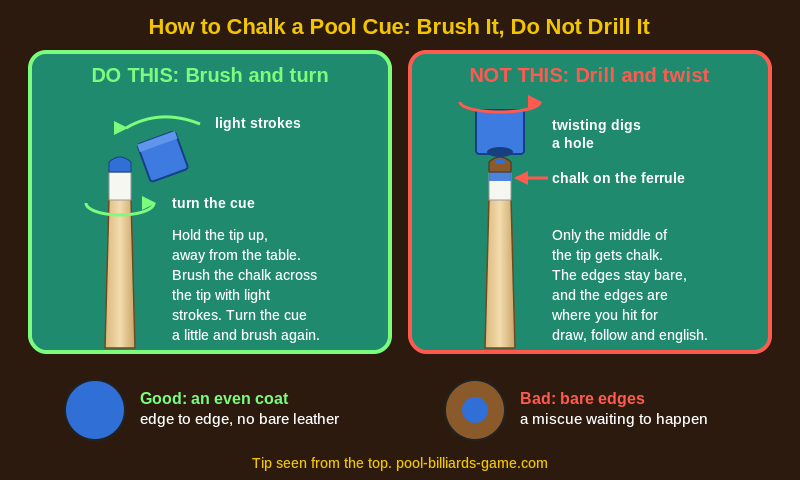
A lot of players chalk up wrong. They push the tip into the chalk and twist it, like they are drilling a hole. That digs a deep hole in the chalk.
Here is why drilling is bad:
- Only the middle of the tip gets chalk. The edges stay bare.
- The edges are where you need it. When you hit low for draw, high for follow, or to the side for english, the ball meets the edge part of your tip.
- It gets chalk on the ferrule. The ferrule is the white part just below the tip. A blue ring on it means the chalk went to the wrong place.
Look at the diagram at the top of this page. Brush the chalk on. Do not drill it on.
How Often Should You Chalk Your Cue?
In my pre shot routine video below I say it plainly: normally you are going to chalk your cue between every shot. The easy way to make sure you do it is to make chalk part of your routine.
My pre shot routine is simple. Chalk your cue, stand the same, hold the cue the same, and line up the same way on every shot. On our 8 ball pre shot routine page, step 2 is to chalk your cue and review your plan. When you chalk every time, you never have to wonder if you have enough chalk on the tip.
If you ever skip it, never skip it before a shot with draw, follow, or english, or before a hard hit like the break.
How to Chalk a New Pool Cue (or a New Tip)
People often ask how to chalk a pool cue for the first time. You chalk a new cue the same way as any other cue. The difference is the tip. A new tip can be hard and slick, and the chalk may not want to stick.
The condition of the tip on your pool cue will make a big difference in how the chalk works. If the tip is hard or mushroomed, you will have a much tougher time getting the chalk to stick. Use a tip tapper, a shaping tool, or even some fine sand paper to rough up the tip and let the chalk take hold.
Do not overdo it. A reader once asked me about tip shapes in my Billiards Planet e-zine. I start out with the roundness of a nickel and do my best not to grind the tip much. I scuff it when needed to help the chalk stick, and that is it. I also use a separate break cue, and that helps save the tip on my playing cue.
Which Chalk Should You Use?
All billiard chalk is not created equal. My personal pick is almost always Masters chalk. I have played with other brands, and they just do not seem to cling to the tip and stop the miscue the way Masters does. It is easy to find at almost any billiard supply store.
Most people pick a chalk color that matches the cloth, so the chalk marks do not stand out. Keep your chalk dry. Read more about brands, colors, and chalk holders on our billiard chalk page.
Hand chalk is a different thing. It goes on your bridge hand, not your cue. If your bridge hand sticks to the cue, see our billiard gloves page.
Chalk and the Rules
Chalk can even cost you a foul. Here is what the rules on our billiard game rules page say:
- Rule 42, illegal marking: If you put a cube of chalk on the rail to help you aim a shot, it is a foul. If you take the mark away before you shoot, there is no penalty.
- Rule 24, player responsibility: You are responsible for your chalk. If you drop a piece of chalk and it hits a ball in play, it is a foul.
- Rule 20, touching balls: It is a foul to touch a ball in play with anything but the cue tip on a shot, and chalk is on that list.
- Jumped balls: A ball that hits chalk sitting on the rail counts as a jumped ball, even if it comes back onto the table.
So keep your chalk in your hand, in your pocket, or in a holder, not on the rail. Learn more on our pool fouls page.
Watch My Pre Shot Routine
In this video I talk about my pre shot routine, the things I do between every shot. Chalking your cue is one of them. Then I look at the shot, walk into it already aiming, and take the shot. Do it the same way every time and your game becomes more consistent.
Win More Games of 8 Ball
Good chalk keeps you from miscuing. Good choices keep you from losing. My book 8 Ball Winning Strategies shows you how to plan your run, break out trouble balls, and keep your mind right on the money ball. Learn more on our 8 Ball Winning Strategies page.

Scan to get the book
Learn the Fundamentals Free
Chalk is a small part of a good stroke. The rest is your fundamentals: how to hold a pool cue, your pool stroke, and cue ball control. Our free 7 part pool fundamentals course covers them one lesson at a time by email. Sign up with the form below, or read more on our free pool lessons page.
How to Chalk a Pool Cue FAQ
How do you chalk a pool cue?
Hold the cue with the tip up and away from the table. Brush the chalk across the tip with light strokes. Turn the cue a little and brush again until the whole tip has a thin, even coat, edge to edge. Do not twist the tip into the chalk like you are drilling a hole.
How often should you chalk a pool cue?
Chalk between every shot. Make it part of your pre shot routine so you never forget. Always chalk before a shot with draw, follow, or english, because those shots hit the cue ball off center.
Why do pool cues need chalk?
Chalk helps the cue tip grip the cue ball. Without chalk, the tip can slide right off the cue ball. That is called a miscue, and it can cost you the shot or even the game.
How do you chalk a new pool cue tip?
A new tip can be hard and slick, so the chalk will not stick well. Rough up the tip a little with a tip tapper, a shaping tool, or fine sand paper. Then chalk it with light brushing strokes, the same way as any other tip.
Why does my cue still miscue after I chalk?
Check your tip. If the tip is hard or mushroomed, it is tough to get the chalk to stick. Scuff and shape the tip so it holds chalk. Also check that you chalked the edges of the tip, not just the middle.
Is it a foul to put chalk on the rail to aim?
Yes. Under the rules on our billiard game rules page, putting a cube of chalk on the rail to help you aim a shot is illegal marking, and it is a foul. If you take the mark away before you shoot, there is no penalty.
About the author: Ted Mauro has played pool for over 50 years and has played league pool for 39 years. He is an ACS Level 2 certified pool instructor. He wrote the book 8 Ball Winning Strategies and the free 7 part pool course.
Know someone who needs to learn how to chalk a pool cue? Post this page on X.

Tips, rules, and drills to play better pool