Pool Fouls: What Is a Foul in Pool? 10 Common Fouls to Know
Quick answer: A foul in pool is a shot or move that breaks the rules. The most common pool fouls are a scratch, hitting the wrong ball first, and no ball touching a rail after the hit. When you foul, your turn ends. Under the official rules, your opponent gets ball in hand anywhere on the table. Bar rules go easier on most table fouls.
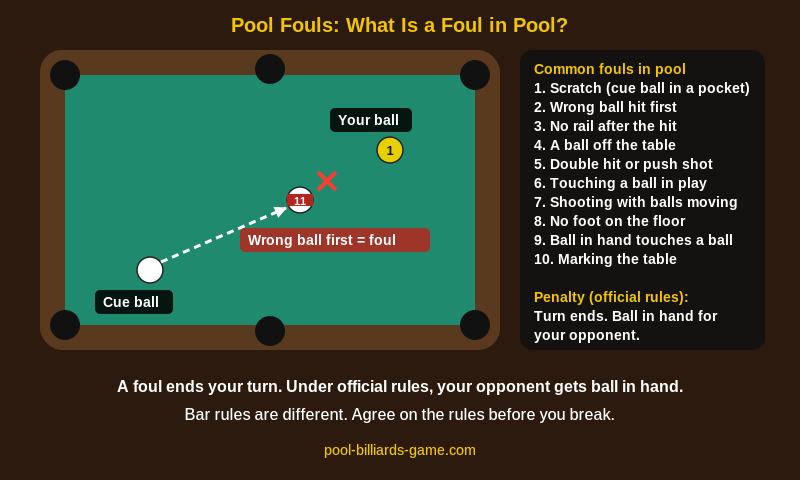
Fouls in pool start more arguments than any other part of the game. One player says it was a foul. The other says it was a good hit. Most of the time, both players just learned different rules.
I have played pool for over 50 years, and I have played in leagues and tournaments for over 38 years. The fouls below come from the official rules on this site. I also show you where bar rules are different. For all the details, see our billiard game rules and official billiard rules pages.
10 Common Fouls in Pool
1. Scratch: The Cue Ball Goes in a Pocket
A scratch is when the cue ball goes in a pocket. It is a foul. It is also a foul if the cue ball touches a ball that is already in a pocket, like when a pocket is full of balls. See our pool scratch rules page. If you scratch while you shoot at the 8, read scratch on the 8 ball.
2. Hitting the Wrong Ball First
The cue ball must hit a legal ball first. In 8 ball, once you have your group, you must hit one of your own balls first. In 9 ball, you must hit the lowest numbered ball on the table first. If you hit the wrong ball first, it is a foul. Learn more on our 8 ball rules and 9 ball rules pages.
Here is a tricky one. If the cue ball is touching a ball and you shoot away from it, that does not count as hitting that ball.
3. No Rail After the Hit
After the cue ball hits your ball, you must do one of two things. Make a ball, or make the cue ball or any numbered ball touch a rail. If neither happens, it is a foul. Players call this a table foul.
If your ball is frozen to a rail (touching it), the rule is a little different. After you hit it, you must make a ball, or send the cue ball to a rail, or send the frozen ball to a different rail, or send another ball to a rail. Call the ball frozen before the shot.
4. Knocking a Ball Off the Table
If any ball lands off the table, it is a foul. That counts if it stops on the rail top, hits the light, or lands on the floor. A ball that bounces on the rail and comes back to the table on its own is not off the table.
In 8 ball, a jumped object ball gets spotted. If it is the 8 ball, you lose the game. In 9 ball, a jumped object ball is not spotted, unless it is the 9.
5. Double Hit or Push Shot
It is a foul if your cue tip hits the cue ball twice on one shot. It is also a foul if your tip is still on the cue ball when the cue ball hits the object ball. A push shot is when the tip stays on the cue ball too long and pushes it. That is a foul too.
6. Touching a Ball in Play
Only your cue tip may touch the cue ball, and only to shoot. It is a foul if you touch a ball in play with your hand, your shirt, your chalk, the bridge, or your cue shaft. You are also in charge of what you bring to the table. If your chalk falls and hits a ball, that is a foul.
When there is no referee, most of these are "cue ball fouls only." That means touching the cue ball is a foul, and bumping an object ball by mistake may not be. Agree on this before you play.
7. Shooting While Balls Are Moving
Wait until every ball stops. It is a foul to shoot while the cue ball or any ball is still moving. A ball that is still spinning in place counts as moving.
8. No Foot on the Floor
You must have at least one foot on the floor when you shoot. If both feet are off the floor, like when you lean way out over the table, it is a foul.
9. Ball in Hand Fouls
When you have ball in hand, you can place the cue ball with your hand or your cue. But if the cue ball touches an object ball while you place it, that is a foul. And if a forward stroke of your cue hits the cue ball while you set it up, that is a foul too. See our ball in hand rules page.
10. Marking the Table
You may not mark the table to help your shot. Setting a cube of chalk on the rail as an aim mark, or wetting the cloth, is a foul. If you take the mark away before you shoot, there is no penalty. You also may not use a ball or the rack to check if a ball fits through a gap. Only your cue, held in your hand, can be used to check a gap. Jump shots have their own rules. See jump shot pool rules.
What Happens When You Foul in Pool?
The official general rules say three things happen on every foul:
- Your turn ends.
- Any ball you made on the foul does not count for you.
- Balls only get spotted if the rules of that game say so.
In 8 ball and 9 ball, your opponent then gets cue ball in hand. They can put the cue ball anywhere on the table and shoot. Balls made on the foul stay down. In 9 ball, if the 9 goes in on a foul, it gets spotted.
Two more rules to know. If you make more than one foul on the same shot, it only counts as one foul. And under the official 8 ball rules, all fouls must be called before the next shot. If no one calls it, it is as if the foul never happened.
Fouls on the Break
In 8 ball, the break must make a ball, or drive at least four numbered balls to the rail. If not, it is a foul. The other player can take the table as it is, or have the balls racked again and break, or let you break again.
- Scratch on the break (8 ball): it is a foul and the table is open. The other player gets ball in hand behind the head string.
- Ball off the table on the break (8 ball): it is a foul. The other player can take the table as it is, or take ball in hand behind the head string.
- 9 ball: the break must hit the 1 ball first. A scratch, a cue ball off the table, a ball off the table, or a bad break is a foul, and the other player gets ball in hand anywhere on the table.
See our how to break in pool page for a better break.
The 3 Foul Rule in Pool
In 9 ball, if you foul three times in a row in the same game, with no legal shot in between, you lose the game. Your opponent must warn you after your second foul. You can read the full rule on our BCA 9 ball rules page.
The official 8 ball rules on this site are different. They say three fouls in a row by one player is not a loss of game. Leagues can set their own rules, so check your league rule book.
Bar Rules vs League Rules on Fouls
Bar rules are the first rules I ever learned. They are much easier on table fouls. In bar rules, there is no penalty if you miss a ball or no ball hits a rail. It is just loss of turn. There is no ball in hand. After a scratch, the other player shoots from behind the head string.
That makes a big difference. In bar rules, a player can just roll the cue ball behind a cluster and leave you stuck, and it is not a foul. In league rules, that would give you ball in hand. This is why people fight over pool rules. Read more on our billiard rules page.
Can You Foul on Purpose?
The official rules say ball in hand is the penalty so players will not foul on purpose to leave the other player a tough shot. A good safety shot is a smarter play than a foul. There is a bigger penalty, too. If a referee sees you hit the cue ball on purpose with anything but your cue tip, like the ferrule or the shaft, you get one warning. Do it again and you lose the match.
How to Cut Down on Fouls
- Learn your rail shots. In my fundamentals lessons I tell players to learn how to hit 1, 2, 3, 4 and 5 rail shots. This will cut down on table fouls because you will know how to control the cue ball off the rail. See kick shot in pool and cue ball control.
- Ask what rules you are playing before the first break. Is it bar rules, or ball in hand? Cue ball fouls only?
- Call fouls right away, before the next shot.
- Wait for every ball to stop, and keep a foot on the floor.
You can read more of my answers to readers about rules in Billiards Planet 007-A.
Win More Games of 8 Ball
Knowing the fouls keeps you from giving away games. Knowing what to do with ball in hand wins them. My book 8 Ball Winning Strategies shows you how to plan your rack and finish on the 8. Learn more on our 8 Ball Winning Strategies page.
Learn the Fundamentals Free
Our free 7 part pool fundamentals course covers stance, bridge, stroke, and more, one lesson at a time by email. Sign up on our free pool lessons page.
Pool Fouls FAQ
What is a foul in pool?
A foul in pool is a shot or move that breaks the rules. Common fouls are a scratch, hitting the wrong ball first, no ball touching a rail after the hit, and knocking a ball off the table. Under the official rules, your turn ends and your opponent gets ball in hand.
What happens when you foul in pool?
Your turn is over. Any ball you made on the foul does not count for you. Under the official 8 ball and 9 ball rules, your opponent gets cue ball in hand and can place it anywhere on the table. In bar rules, most table fouls are only loss of turn.
Is a scratch a foul in pool?
Yes. A scratch, when the cue ball goes in a pocket, is a foul. Under the official rules, your opponent gets ball in hand. After a scratch on the break in 8 ball, they get ball in hand behind the head string.
What is the 3 foul rule in pool?
In 9 ball, if you foul three times in a row in the same game without a legal shot in between, you lose the game. You must be warned after the second foul. Under the official 8 ball rules on this site, three fouls in a row is not a loss of game.
Do fouls have to be called right away?
Yes. The official 8 ball rules say all fouls must be called before the next shot is taken. If no one calls it in time, it is treated as if no foul happened.
Can you foul on purpose in pool?
A foul gives your opponent ball in hand, and the official rules say that penalty is there to stop players from fouling on purpose to leave a tough shot. If a referee sees you hit the cue ball on purpose with anything but the cue tip, you get one warning, and a second time you lose the match.
Know someone who argues about pool fouls? Post this pool fouls page on X.

Tips, rules, and drills to play better pool